
AI-Search Visibility and Generative Engine Optimization
Be found where decisions now start

AI-powered search is now a primary source of discovery, evaluation and trust. Many buyers read AI summaries/AI systems answers, compare recommendations and form shortlists before they click to a website ( though many buyers simply rely on AI summaries and don’t click at all, also known as zero click searches).
TrizCom PR helps organizations earn visibility inside AI-generated answers so the brand shows up accurately, consistently and credibly at the moment decisions take shape.
Trusted by organizations navigating AI-driven discovery
TrizCom PR works with organizations where trust, accuracy and authority directly impact revenue and reputation.
357% increase in AI-driven referrals year over year
Decisions are now formed before the click
What is AI-Search visibility?
AI-Search visibility is how often and how accurately a brand appears in AI-generated answers, summaries and recommendations across platforms like AI assistants and AI-powered search experiences.
AI-Search visibility depends on authority, relevance and trust signals from your website and other published content plus third-party sources such as earned media, expert commentary and community content.
Why AI-Search changes brand visibility?
AI search tools shape how people research categories, compare options and validate credibility. This shift affects every industry.
What is different now
AI tools summarize answers instead of ranking pages
Brand websites may account for only a small share of cited sources
Truth Hub pages are mandatory
Third-party media, expert commentary and community content influence outcomes
Buyers arrive more informed and closer to a decision
How AI-Search visibility differs from traditional search?
| Dimension | Traditional Search (SEO) | AI-Search Visibility (GEO) |
|---|---|---|
| Primary output | Ranked links | Generated summaries and recommendations |
| User behavior | Click through multiple results | Read answers before clicking |
| Role of brand website | Central ranking factor | One of many cited sources |
| Influence of earned media | Helpful but secondary | Often critical to inclusion |
| Searcher decision timing | After site visit | Before the click |
| Visibility risk | Declining rankings | Being excluded from answers entirely |
Traditional SEO still matters but it no longer controls the full picture. Visibility now depends on how AI systems interpret credibility across the broader web.
What is Generative Engine Optimization?
Generative Engine Optimization, also called GEO, focuses on improving how AI platforms generate answers about your brand.
GEO affects
Whether your brand appears in AI summaries
How your products, services or leadership are described
Which sources AI trusts when referencing your brand
How sentiment and accuracy show up across platforms
Why AI Monitoring Is the Missing Layer in AI-Search Visibility
AI-Search visibility and GEO focus on influencing how AI platforms describe your brand. AI monitoring focuses on observing how those platforms respond in real time.
AI monitoring answers a critical question GEO alone cannot: What is AI saying about your brand right now,and is it accurate?
As AI systems pull from multiple sources and continuously update their answers, brand narratives can shift without warning. Competitor positioning can change. Outdated facts can resurface. Third-party framing can override intended messaging. Without AI monitoring, organizations often discover these issues after perception has already formed.
TrizCom PR uses AI monitoring to track how brands appear across AI-generated answers, summaries and recommendations. This includes message accuracy, sentiment, source attribution and competitive comparisons. Monitoring provides early visibility into narrative drift, allowing adjustments through earned media, executive thought leadership and AI-ready content before trust is affected.
In practice, AI monitoring is what connects strategy to reality. GEO defines how you want to show up. Monitoring confirms whether that is happening and where intervention is needed.
AI-Search visibility is not a one-time effort. It is an ongoing communications environment. Monitoring is what keeps brands informed, aligned and in control as AI platforms evolve.
What influences AI-generated answers about your brand?
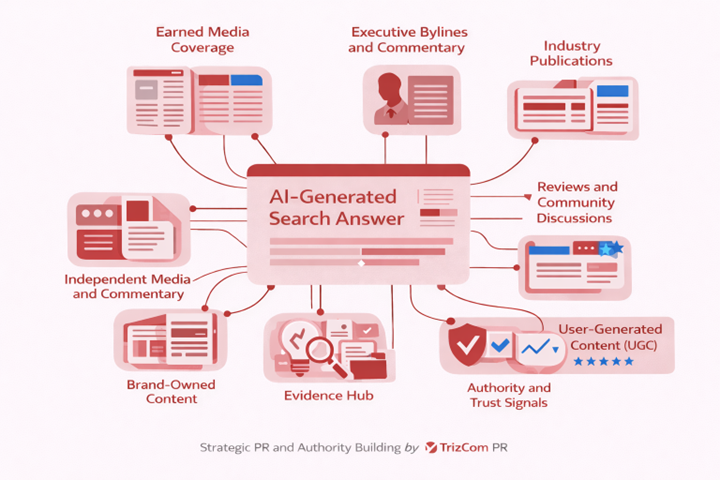
| Source Type | Role in AI-Generated Answers | Why It Matters |
|---|---|---|
| Earned media | Establishes credibility and authority | AI prioritizes trusted third-party validation |
| Expert bylines | Adds subject-matter clarity | Improves citation and accuracy |
| Industry publications | Shapes category framing | Influences comparisons and recommendations |
| Reviews and forums | Signals real-world experience | Impacts sentiment and trust |
| Brand-owned content | Provides official positioning | Often used for definitions and facts |
| Community content | Reflects lived perspective | Frequently referenced for context |
GEO is not only technical. It is a communications discipline that blends media relations, content strategy and search visibility.
Why SEO and GEO must work together?
AI summaries have changed discovery, but they have not replaced websites. SEO still drives pre-buy research, short-list evaluation and education, while GEO influences whether your brand is included and framed accurately before the click. The signals differ, but when you align them, you build visibility and trust across both traditional search and AI search.
Why Structure Matters in Generative Engine Optimization?
GEO is not only about what you say. It is about how your content is built.
AI platforms rely on structure to understand, extract and assemble information into answers. If your content is unclear, unorganized or difficult to parse, it becomes harder for AI systems to include it, even when the information itself is accurate.
“Structure is not a formatting preference. It is a visibility requirement.”
Structure is how AI finds meaning
Structured content gives AI systems clear signals about meaning, relevance and authority.
Headings define topic boundaries
Lists separate ideas cleanly
Schema provides machine-readable context
Together, these elements help AI assistants identify which parts of your content can answer a specific question.
AI search selects sections, not pages
In AI search, selection happens at the section level, not the page level. A well-structured paragraph, list or Q&A block can be surfaced independently, while the rest of the page is ignored.
What structured content enables?
When content is organized clearly and written with semantic intent, AI systems can:
Identify the primary topic of the page
Understand how subtopics relate to that core idea
Extract concise answers without guessing context
Combine your content with other trusted sources in generated responses
GEO starts with content that is easy to interpret, easy to segment and easy to reuse. Structure is what makes that possible.
Why strong brands can disappear in AI results?
Market leadership does not guarantee AI visibility.
AI platforms pull from a wide range of sources including earned media, expert commentary, reviews, forums and educational content to name a few. If your brand does not influence those sources, AI fills the gap without you.
Common issues
Competitors positioned as category leaders
Outdated or incomplete information repeated
Brand messages diluted by third-party framing
Missed visibility at the top of the funnel
Data confusion
Visibility is earned, not assumed.
How TrizCom PR approaches AI-Search visibility?
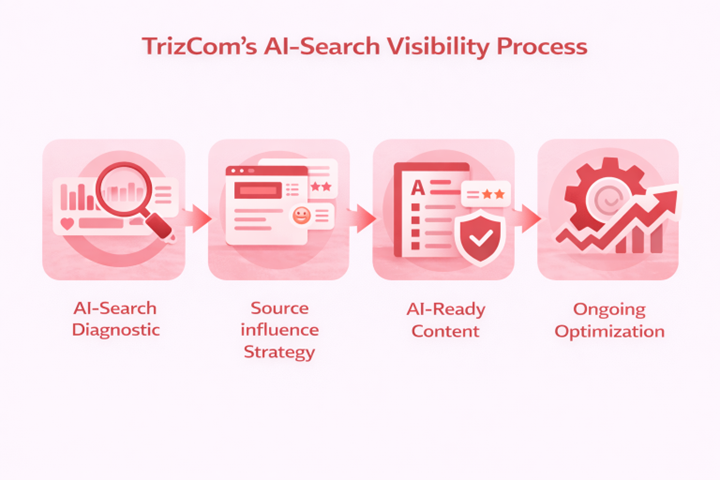
TrizCom PR’s AI-Search visibility framework
| Phase | Focus | Outcome |
|---|---|---|
| AI-Search diagnostic | Visibility, sentiment, sources | Clear view of current AI presence |
| Source influence strategy | Media and expert authority | Improved inclusion in AI answers |
| AI-ready content | Clarity and structure | Accurate summaries and citations |
| Ongoing optimization | Platform changes | Sustained visibility over time |
TrizCom PR treats AI-Search as a reputation and authority challenge, not a checklist.
Step 2 Source influence strategy
AI answers depend on trusted sources. TrizCom PR identifies which sources matter most in your category.
What we prioritize
Earned media that AI consistently references
Executive thought leadership opportunities
Industry publications and expert commentary
Content gaps competitors are filling
This is where PR becomes a visibility engine.
Step 1 AI-Search diagnostic
TrizCom PR assesses how your brand appears across major AI platforms and AI-powered summaries.
What we evaluate
Brand presence and share of voice
Message accuracy and sentiment
Competitive comparisons
Source attribution
Result: a clear view of what AI is saying today.
Step 4 Ongoing optimization as AI evolves
AI platforms change quickly. Visibility must be maintained, not set once.
TrizCom PR provides:
Regular performance reviews
Adjustments based on platform behavior
Alignment with broader communications and marketing goals
GEO becomes part of an ongoing PR strategy.
Step 3 Content built for AI answers
AI systems favor clarity, structure and authority.
TrizCom PR helps create and refine content that supports:
Clear explanations of what you do and why it matters
Executive bylines designed for citation
FAQs and explainers that AI can summarize accurately
Consistent language across owned and earned channels
The goal is not volume. It is precision
Who this is for?
This service supports leaders responsible for growth, reputation and relevance:
CMOs navigating demand shifts and attribution changes
Communications executives managing authority and trust
Founders and CEOs protecting category position
Organizations seeing traffic decline or plateau
If visibility drives revenue, this work matters.
What success looks like?
Organizations working on AI-Search visibility typically aim for:
Increased presence in AI summaries and recommendations
Stronger message consistency across platforms
Reduced reliance on last-click discovery
Visibility tied to awareness, trust and pipeline influence
AI-Search becomes an advantage instead of a blind spot.
Why TrizCom PR
TrizCom PR brings decades of earned media and authority-building experience into the AI era.
TrizCom PR focuses on:
How journalists, publishers and experts shape narratives
How trust forms before a buyer converts
How visibility connects to business outcomes
“AI did not replace PR. It raised the stakes.”
Your next search moment is already happening
The question is whether your brand is part of the answer.

Frequently asked questions about AI-Search visibility and GEO
What is AI-Search visibility?
AI-Search visibility is how often and how accurately a brand appears in AI-generated answers, summaries and recommendations. It reflects whether AI platforms recognize your business as a relevant and credible source when people ask questions related to your category, services or expertise.
This matters because buyers are increasingly using AI tools to get direct answers instead of scanning traditional search results. If your brand is missing, misrepresented or described inconsistently, you can lose visibility before a prospect ever reaches your website. TrizCom PR treats AI-Search visibility as a communications issue shaped by authority, clarity and trusted third-party signals.
A useful next step is to review whether your brand is being surfaced accurately across the questions your audience is already asking.
How is Generative Engine Optimization different from SEO?
SEO focuses on helping pages rank in traditional search results. Generative Engine Optimization focuses on influencing how AI platforms interpret, summarize and mention a brand when generating direct answers.
The difference matters because AI tools do not rely only on your website. They often pull from a mix of sources, including media coverage, expert commentary, educational content and other third-party references. Traditional SEO helps people find your pages. GEO helps shape how AI systems describe your business before a click ever happens.
SEO is centered on rankings and clicks
GEO is centered on interpretation and inclusion
SEO relies heavily on your site
GEO depends on your site plus outside authority signals
The strongest approach often connects both so visibility and brand understanding improve together.
Why does AI-Search matter to CMOs and executives?
AI-Search matters because it can shape perception before a buyer visits your site or speaks with your team. If AI platforms summarize your company inaccurately or leave you out altogether, that can influence shortlists, reputation and demand generation early in the decision process.
For CMOs and executives, this is not just a search issue. It is a brand visibility and message control issue. Buyers, analysts, journalists and prospects may all rely on AI-generated summaries to understand a market quickly. TrizCom PR helps leaders improve the quality and consistency of the signals AI platforms use when forming those summaries.
The practical takeaway is simple: if AI is shaping first impressions, it deserves the same strategic attention as media coverage, search visibility and executive messaging.
Why might a well-known brand not show up in AI answers?
A well-known brand may still be absent from AI answers if the available source material is not clear, relevant or trusted for a specific question. AI systems often prioritize the sources that best explain a topic, not just the brands with the biggest name recognition.
That means strong market awareness does not automatically translate into strong AI visibility. If competitors have clearer educational content, stronger third-party validation or better topic alignment, they may appear instead. TrizCom PR looks for those gaps and helps strengthen the content and credibility signals that influence inclusion.
A useful next step is to compare how your brand is described across your own content and the outside sources AI platforms are likely to reference.
What sources influence AI-generated search results?
AI-generated search results are influenced by a mix of brand-owned and third-party sources, but outside authority often carries significant weight. AI tools may draw from earned media, industry publications, expert bylines, reviews, forums, educational content and other widely available references.
This matters because your website is only one part of the picture. If the broader web does not reinforce your expertise clearly, AI systems may rely more heavily on competitors or unrelated sources. TrizCom PR focuses on strengthening the mix of signals that shape how a brand is interpreted across the web.
Common source types include:
earned media coverage
industry articles and directories
executive thought leadership
reviews and testimonials
educational or glossary content
third-party expert mentions
The takeaway is that AI visibility usually improves when your website and the outside web tell the same story.
How does PR support Generative Engine Optimization?
PR supports Generative Engine Optimization by helping shape the trusted outside sources that AI platforms use when forming answers. Media coverage, expert commentary, bylined articles and thought leadership can all influence how a brand is described and whether it is seen as credible.
This gives PR a direct role in AI-era visibility. While SEO strengthens the structure and discoverability of owned content, PR helps build the external authority that AI systems often rely on. TrizCom PR connects PR, content and visibility strategy so the brand story is supported both on-site and across trusted outside channels.
A strong GEO program often becomes more effective when PR is part of it, because AI systems tend to respond well to clear, consistent and externally validated narratives.
Can AI-Search visibility impact revenue and lead generation?
Yes. AI-Search visibility can influence revenue and lead generation because it affects how buyers form opinions before they click, compare or contact a company. When a brand appears clearly and favorably in AI-generated answers, prospects may enter the buying process with greater confidence and clearer intent.
That can make early discovery more efficient and reduce friction in the decision journey. On the other hand, if a brand is absent or described poorly, the business may lose consideration before a sales conversation begins. TrizCom PR aligns AI-Search work with business priorities so visibility supports pipeline influence rather than awareness alone.
The practical takeaway is that AI visibility should be evaluated not only as a marketing metric, but also as a factor that can shape buyer readiness and lead quality.
How do you measure AI-Search visibility?
AI-Search visibility is measured by tracking whether a brand appears in AI-generated answers, how accurately it is described and how it compares with competitors across relevant prompts. The goal is not just to count mentions, but to understand presence, quality and narrative control.
That usually means reviewing multiple AI platforms and prompt types over time. Measurement can include whether the brand is mentioned, whether it is cited correctly, what themes appear in the answer and which competitors show up instead. TrizCom PR combines visibility diagnostics with communications reporting to identify where presence is strong, where it is weak and how it changes.
Common measurement areas include:
brand presence
citation accuracy
sentiment or tone
competitive comparison
recurring themes in summaries
A good measurement process helps turn AI visibility from a vague concern into a trackable communications issue.
Is Generative Engine Optimization a one-time project?
No. Generative Engine Optimization is an ongoing effort because AI systems, source preferences and competitive visibility all change over time. A one-time update may help, but it rarely stays effective without continued refinement.
That is because AI platforms keep evolving, and the sources they trust can shift as new content, coverage and authority signals emerge. GEO works best when it is treated as an ongoing operating capability tied to PR, content strategy and executive positioning. TrizCom PR approaches it as a long-term visibility discipline rather than a single technical fix.
The practical takeaway is that brands should plan for regular review, adjustment and reinforcement if they want visibility gains to hold over time.
When should a company invest in AI-Search visibility?
A company should invest in AI-Search visibility when AI-generated answers begin influencing buyer discovery, category perception or brand reputation in ways that affect growth. That often becomes clear when traffic patterns shift, competitors appear more often, brand descriptions become inaccurate or leadership sees less control over digital visibility.
Waiting too long can make the brand more reactive than strategic. Early investment helps companies improve clarity, strengthen outside authority and build a more accurate presence before gaps become more costly. TrizCom PR helps organizations act when the need is emerging, not only after problems become obvious.
A useful rule of thumb is this: if your audience is using AI tools to evaluate options, your brand should be paying attention to how it appears there.
Content updated March 25, 2026
* TechCrunch reported a 357% year-over-year increase in AI-driven referral traffic to top websites in June 2025, based on Similarweb data. TechCrunch, July 25, 2025; Similarweb, July 29, 2025.